
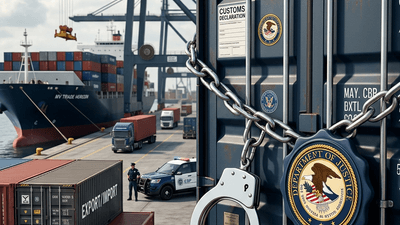



For decades, customs compliance was largely viewed by corporate America as an administrative burden—a domain of routine audits, complex paperwork, and the occasional administrative penalty levied by U.S. Customs and Border Protection (CBP). Today, that paradigm has violently shifted. The era of treating tariff errors as mere slip-ups is over. The Department of Justice (DOJ) has recognized a lucrative and politically salient new frontier in corporate enforcement, aggressively targeting customs and tariff fraud using its most devastating weapon: the False Claims Act (FCA).
This pivot fundamentally alters the risk calculus for global supply chains. For in-house counsel, white-collar defense attorneys, and trade compliance professionals in the United States, the escalation from administrative fines to civil and criminal DOJ prosecution requires a complete recalibration of internal auditing and risk management. As highlighted in a recent insight by Latham & Watkins, the DOJ is ramping up enforcement actions regarding customs and tariff fraud, making it imperative for global companies to proactively mitigate their exposure.
The Shift in Enforcement: From CBP Audits to DOJ Prosecutions
The catalyst for this aggressive posture is rooted in the shifting geopolitical landscape of global trade. With the imposition of Section 301 tariffs on Chinese goods, Section 232 tariffs on steel and aluminum, and the enforcement of the Uyghur Forced Labor Prevention Act (UFLPA), the financial incentive for companies to evade duties has skyrocketed. Where there is a financial incentive to cheat, the DOJ inevitably follows.
Historically, customs enforcement was primarily the purview of CBP, which relied on administrative mechanisms. While CBP still plays a critical role in interdicting goods and issuing penalties, the DOJ has stepped in to handle the most egregious—and financially significant—cases. This involves a coordinated effort between the DOJ's Commercial Litigation Branch (which handles FCA cases), the Criminal Division, and Homeland Security Investigations (HSI).
"The transition from administrative oversight to proactive DOJ enforcement signifies a maturation in how the U.S. government views trade compliance. It is no longer just about collecting revenue; it is about national security, fair competition, and punishing corporate malfeasance."
The Weapon of Choice: The False Claims Act
The vehicle driving this new wave of enforcement is the False Claims Act. Originally designed to combat fraud by defense contractors during the Civil War, the FCA imposes liability on persons and companies who defraud governmental programs. In the context of customs, this takes the form of "reverse false claims"—making a false statement to avoid or decrease an obligation to pay money to the government (i.e., tariffs and duties).
The FCA is uniquely dangerous for corporate defendants for two primary reasons:
- Treble Damages and Penalties: The FCA allows the government to recover three times the amount of the unpaid duties, plus per-claim statutory penalties that can quickly escalate into the tens of millions of dollars.
- The Qui Tam Provision: The FCA empowers private citizens (whistleblowers or "relators") to file suits on behalf of the government and share in 15% to 30% of the recovery. This has created a cottage industry of whistleblowers, including disgruntled current or former employees, and increasingly, rival companies who suspect their competitors of gaining an unfair market advantage through tariff evasion.
The "Big Three" Customs Fraud Typologies
According to recent DOJ enforcement patterns and the analysis provided by Latham & Watkins, prosecutors and whistleblowers are primarily targeting three distinct categories of customs fraud. Legal counsel must train their compliance teams to scrutinize these specific areas.
1. Misclassification of Goods
Every product imported into the United States must be classified under the Harmonized Tariff Schedule of the United States (HTSUS). Because tariff rates vary wildly between classifications, importers are often tempted to classify goods under a heading that carries a lower duty rate, or one that avoids punitive Section 301 tariffs entirely. The DOJ has successfully prosecuted numerous companies whose internal communications revealed a deliberate strategy to "shop" for cheaper, albeit inaccurate, HTSUS codes.
2. Undervaluation and Transfer Pricing Manipulation
Customs duties are generally assessed ad valorem—based on the value of the imported goods. Companies may attempt to lower their duty burden by submitting fraudulent invoices to CBP that understate the true price paid. This becomes particularly complex in related-party transactions, where transfer pricing policies designed for tax optimization may run afoul of customs valuation rules. The DOJ looks for discrepancies between the value declared to CBP and the value recorded on internal financial statements or paid to the foreign supplier.
3. Transshipment and Country of Origin Evasion
With steep tariffs imposed on goods originating from specific countries (notably China), some importers route their products through third countries (e.g., Vietnam, Malaysia, or Mexico) to disguise the true country of origin. This often involves minimal processing or simply repackaging the goods in the intermediate country. If the processing does not meet the legal threshold for a "substantial transformation," the original country of origin remains, and falsely declaring otherwise is a direct violation of the FCA.
Comparing the Exposure: CBP vs. DOJ
To truly understand the gravity of this shift, counsel must communicate the difference in exposure to their executive boards. The following table illustrates the stark contrast between traditional administrative enforcement and FCA litigation.
| Feature | Traditional CBP Enforcement | DOJ FCA Enforcement |
|---|---|---|
| Primary Mechanism | Administrative penalties, liquidated damages | Civil litigation and/or criminal prosecution |
| Financial Exposure | Fines based on culpability (negligence to fraud) | Treble (3x) damages plus per-claim statutory penalties |
| Discovery Trigger | Routine CBP audits, random port inspections | Whistleblowers (Qui Tam relators), competitor tips |
| Evidentiary Standard | Strict liability or negligence often sufficient for fines | Requires "Scienter" (actual knowledge, deliberate ignorance, or reckless disregard) |
Strategic Mitigation for US Legal Professionals
As the DOJ sharpens its focus, reactive compliance is no longer a defensible strategy. Legal professionals advising corporate clients or serving as in-house counsel must implement proactive mitigation strategies to insulate their organizations from FCA liability.
1. Institute Cross-Functional Auditing
Customs compliance can no longer live in a siloed logistics or procurement department. Legal counsel must ensure that data is reconciled across functions. The valuation declared to CBP must align with the transfer pricing data managed by the tax department and the financial data overseen by the CFO. Disconnects between these departments are the fertile ground where FCA cases take root.
2. Revamp Internal Whistleblower Mechanisms
Because the vast majority of FCA customs cases are initiated by qui tam relators, a company's internal reporting hotline is its first line of defense. Counsel must ensure that internal complaints regarding trade compliance are escalated immediately to the legal department, not just HR or logistics managers. Investigating and remediating these complaints internally—and considering voluntary self-disclosure to CBP or the DOJ—can preempt a disastrous whistleblower lawsuit.
3. Elevate Trade Compliance in M&A Due Diligence
Under the FCA, successor liability is a profound risk. When acquiring a company, the acquiring entity can inherit the target's historical customs fraud liabilities. M&A counsel must expand their due diligence checklists to aggressively scrutinize the target's supply chain, particularly if the target relies heavily on imports from Asia. This includes reviewing HTSUS classifications, country of origin documentation, and past CBP inquiries.
4. Implement Supply Chain Forensics
Relying solely on a foreign supplier's word regarding the country of origin is increasingly viewed by the DOJ as "reckless disregard." Companies must implement forensic supply chain tracing, requiring suppliers to provide bills of materials, production records, and facility audits to prove that goods are actually manufactured where they claim to be.
Conclusion
The weaponization of the False Claims Act in the realm of customs and tariff enforcement represents a permanent maturation of U.S. trade policy. The DOJ has discovered that policing global supply chains through the lens of corporate fraud is not only highly lucrative for the Treasury, but deeply effective in enforcing geopolitical trade barriers.
For U.S. law firms and corporate counsel, the mandate is clear: the days of treating customs declarations as mere paperwork are over. By embracing rigorous supply chain forensics, cross-functional auditing, and a proactive stance on internal investigations, legal professionals can guide their organizations safely through this perilous new frontier of DOJ enforcement. Failing to do so invites not just regulatory scrutiny, but the existential threat of treble damages and the relentless pursuit of the modern whistleblower.