Protect your enterprise from hidden liabilities, secure sensitive data, and build actionable governance frameworks for safe workplace AI adoption.
Generative AI tools are increasingly being adopted by employees outside formal enterprise approval processes. Employees are uploading documents into public AI systems, using AI-generated outputs in business workflows, integrating AI tools into software development environments, and making operational decisions influenced by models that may not have undergone legal, security, or compliance review. For many organizations, the greatest AI risk is no longer a future deployment strategy — it is the uncontrolled use of AI already occurring inside the business.
This session examines the legal and governance challenges created by employee use of AI systems within organizations. The course explores policy design, data protection considerations, confidentiality risks, intellectual property concerns, governance structures, vendor evaluation issues, and practical approaches for balancing innovation with legal and operational controls. Participants will gain practical insight into how organizations can move beyond blanket AI bans toward governance frameworks that support responsible and defensible use.
Key Topics Discussed:
Understanding shadow AI in organisations
Employee use of public AI tools and legal exposure
Confidential information and data leakage risks
Intellectual property ownership and AI-generated content
Privacy and data processing considerations
AI use in software development environments
Vendor due diligence and procurement issues
Internal AI policies and acceptable use frameworks
Governance committees and oversight structures
Monitoring, enforcement, and training approaches
Emerging regulatory expectations
Practical implementation challenges

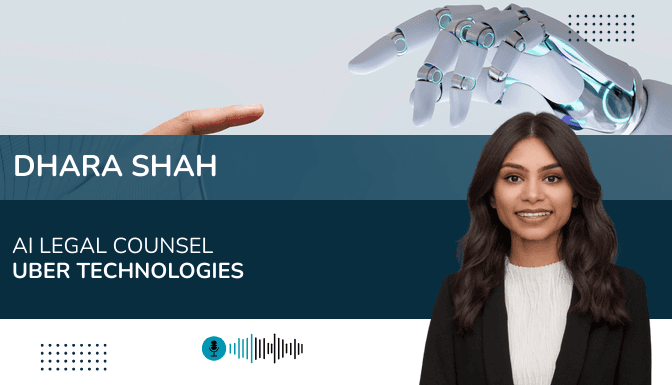
AI Legal Counsel | Uber Technologies
Dhara Shah is AI Legal Counsel at Uber Technologies, an IAPP Certified AI Governance Professional (AIGP), and a licensed attorney. She leads cross-functional initiatives to operationalize responsible AI, including developing AI policies, governance frameworks, model inventories, documentation standards, and oversight processes across legal, technical, and business teams. Her work also focuses on translating emerging AI regulatory expectations into practical governance mechanisms that organizations can implement at scale. Beyond her work at Uber, Dhara actively contributes to shaping the field of AI governance. She serves as Chair of the IAPP AI Governance Affinity Group and has contributed to leading AI policy and governance initiatives, including the NIST Generative AI Working Group and the EU AI Act Code of Practice. With prior experience in BigLaw and a technical foundation in programming, she bridges stakeholders across legal, engineering, and business functions.
