Master the shift from basic prompting to deploying autonomous AI agents that execute complex legal workflows, elevate case strategy, and future-proof your practice.
The first generation of legal AI focused largely on isolated tasks such as document summarisation, legal research, and drafting assistance. Increasingly, however, legal technology is shifting toward agentic systems capable of monitoring matters, tracking deadlines, analysing documents, generating work product, and coordinating legal workflows across multiple systems with limited user intervention. As these technologies evolve, legal professionals face increasingly complex questions around supervision, privilege, competence obligations, liability exposure, and operational control.
This session examines agentic AI within legal practice from a practical and risk-management perspective. The course explores how autonomous and semi-autonomous systems are changing legal workflows, matter management, and client service models while considering the legal, ethical, and operational challenges that emerge when AI moves beyond assistance toward decision support and workflow execution. Participants will gain practical insight into evaluating opportunities and risks as AI becomes more deeply embedded within legal practice.
Key Topics Discussed:

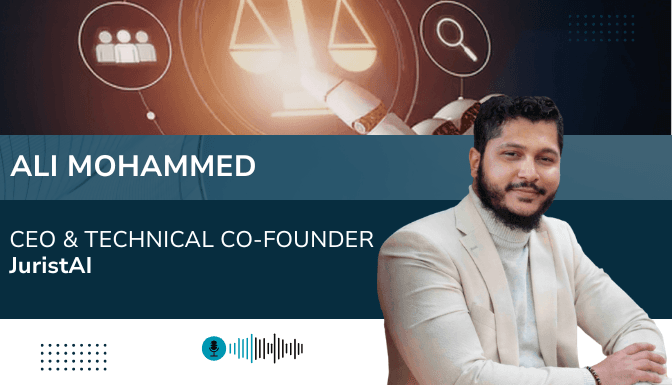
CEO & Technical Co-Founder | JuristAI
Ali Mohammed is the CEO and Technical Co-Founder of JuristAI, where he focuses on developing AI-driven solutions to improve legal workflows and increase access to legal technology. With a background spanning software engineering, cloud technologies, and artificial intelligence, he combines technical expertise with a strong interest in the future of legal innovation. Ali has built and contributed to a range of technology projects, including open-source software shared through GitHub, and regularly writes and speaks about the intersection of AI, law, and human-centered technology. His work explores how emerging technologies can streamline legal processes while keeping people at the center of legal services. He holds a Master's in IT Management and a bachelor's degree from Western Governors University. He has also earned multiple industry certifications in cloud computing, IT, blockchain, and cybersecurity. Through JuristAI and his broader work in the legal technology community, Ali is committed to advancing practical, responsible applications of artificial intelligence for the legal profession.
